
so you might have seen them already but! feeling the need for some visual text-tone xx rooooaaaarrrr!!
 Rach, Marnie, Clare, you'd all look hot in these. Old/new YUSSRach, Marnie, Clare, you'd all look hot in these. Old/new YUSS
1.
When Beatrice Krill's best friend came out to her folks they took her to Disneyland. Beatrice's parental unit (consisting of one parent who did the job of the two or more standard units) had ceased with the holiday thing a long time ago, but Beatrice's own coming out lent the no-holidaying policy a far more imposed air. In fact, this air possessed a quiet aggression that would slip in and out of subterfuge, often taking Beatrice's breath away. While this was going on, Beatrice became much closer to her aunt. Her aunt seemed to understand that every person on the planet had a sexuality and did not assume that Beatrice was the only one afflicted. Beatrice's parental unit on the other hand seemed to conflate her 'predilection' for the same sex with something that resembled a conglomerate - part wolf, part irreverent glossy red eye - and not in a good way.
2.
What is it about best friends that makes them so sexy? Eva says as she flicks her cigarette at Sam accusingly. People who know stuff have traced the predicament back even farther than the Ancient Greeks, Sam says. Experts have so far shown that the best friend thing was born out of the effing dance of a particle and a wave; alien forces incapable of acts that didn't in some way correspond. The wave and particle talked, if you will, across space and time in a tedious, um, gay way, and they often had to shout as each shoplifted (Sam picks up a pair of pantyhose and conceals the packet beneath Eva's coat) at alternate ends of the Mall, I mean, universe. One night they discover that in the body is a muscle-listener, tenderness, a tongue tinned, quiet with lowly oxygen. Another afternoon they see that in this observance bells are cast, pores ring, temperature is right and favourable conditions melt to music. Their laughter goes on to show that life, without bells or hands to warm them, is lost in thought, or hope – anywhere close.

In the spirit of Risk, of boldness. Although I like Cunty Place standing alone I see the desire for something more poetic too. So a tie-in to the over-sexualised after dark culture of Courtney place bars (like El Horno - is this self reflexive??) with the c-word - which projects an aggressive stand on (non-gendered) female sexuality. There is a suggestion of a sinister side to the street - risk for who? Cunty place is an off-hand colloquial term, an insiders outsider joke (or an ousiders insider joke?) but also reclaims and represents an objectifying term (in the good ol post-fem way).
Or not? Am I being simplistic? Is it too Dao Wow perhaps?
"I started writing the one-sentence stories when I was translating Swann's Way," she recalls. "There were two reasons. I had almost no time to do my own writing, but didn't want to stop. And it was a reaction to Proust's very long sentences. The sheer length of a thought of his didn't make me recoil exactly – I loved working on it – but it made me want to see how short a piece of fiction could be that would still have a point to it, and not just be a throwaway joke."
- Lydia Davis
she’s been hanging around her a lot lately
the events of Wednesday night made her question whether she did in fact have an injury
all the boys and girls they abandoned that time in the heatwave
she fully questions her motive for following in its wake
no chairs were available which meant the lesbians had to stand
we have moved beyond a merely reactionary response to industry concerns with balls
in a small part of the country a rumour is substantiated by its small claim
marvelous inconsistencies that included a wolf and an irreverent glossy-red eye
bury me next to Cynthia, her shadow had dignity
we nap in preparation as others have done before us
blind anticipation and subsequent training
the athletic heart, a quarterly digest
the door is in her chest and someone has been knocking on it for several hours
the sea comes in all directions, sometimes a wind of miniature anchors drifting on her skin
 For the image to fill the entire lightbox, 2595mm x 995mm:
 For a portrait image, full width of lightbox (eg. such as Marnie's test)**
 For a landscape image, full width of lightbox **
She would remove her glasses and begin at the farthest point her sight allowed a figure to be defined. The closer the figure got, the harder it became for her to see in any detail the figure as it persisted into near distance. Sometimes she would resort to her prescription lenses to take in the full force of the figure’s advance.

What risks are we taking?Where are they located ?...within the public nature of the personal reveal?...within the public statement that is made?
Who do we want to speak to?Who do we/want to represent in doing so?
In what ways can we acknowledge our subjectivity?Is acknowledging this subjectivity enough?
How do we want to position our own subjectivity within the project to the wider GLBT context?Could we utilise the title to address some of these issues?

 I'm excited at the radical prospect raised in our recent skype of 'removing' the image in a couple of lightboxes (in place of text or smaller image) is another platform to consider material for and the possibilities it opens up. I'm interested in the proposition to 'jar' with the accepted space of the 2-year-old lightboxes, and layer the work on the surroundings - possibly stimulating a similar space to how Sharon Hayes' work operates/engages with people in the first person.
 Edgar Schmitz and Liam Gillick, Inverted Research Tool, 2006. image: Van Abbemuseum
What could these modes of attention be liberated for? Could they be made use of in some other ways? Could they become an instrument of liberation, as in the Inverted Research Tool (Edgar Schmitz and Liam Gillick)? [, 'Turning' e-flux]And what happens if the image area is limited to a small area?
 (Thanks Liz for the borrowed-borrowed images!)
 Unknown, Gabrielle d'Estrées et une de ses soeurs, 1594


 "Diana Fuss tackles most directly the mobilisation of a lesbian gaze within this cultural field [fashion photography] which ‘provides a socially sanctioned structure in which women are encouraged to consume, in voyeuristic if not vampiristic fashion, the images of other women’ (Fuss, 1994:211). For Fuss this process by which women come to look as though they were lesbians entails, as she put it, ‘consuming’ images of women whose poses range from the coy to the aggressive. And this spectorial position is triggered by the distinctive codings which are specific to fashion photography many of which rely on, as Rabine points out, the fragment of the body, showing body parts in pieces, cropping the body to show either torso, or legs or in the case of the images Fuss looks at, seemingly disembodied faces ‘detatched from any visible body. These images of body parts .... "


 So, following up Liz's comment/link from So Gay Right Now, here's a collection of herstories through audio, navigating through New Zealand's 1986 law reform: Radio New Zealand: 20 Years Out! (2006). To play excerpts, see index on the right hand side.
 From a recent BBC report about attacks on Ugandans outed as gay.

 From Wikipedia: Homosexuality in society


 Sharon Hayes & Andrea Geyer History is Ours, The Future is Unthinkable, 2010

 In the Near Future,

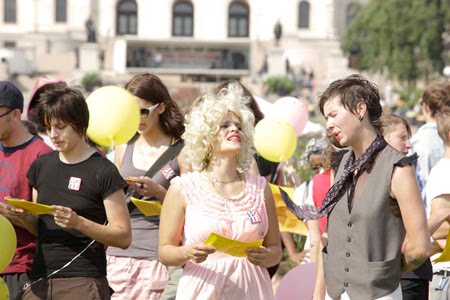
 Revolutionary Love: I am Your Worst Fear, I am Your Best Fantasy, 2008

"Queer criticism has prompted the emergence of different forms of sexual and gender visibility, enabling the articulation of a whole range of micro-discourses and alternative political and cultural forms that defend the concepts of queer feminism and transfeminism, emphasising the validity of their politics from post-identity parameters that are critical of sexual binaries.
But what is the connection between these new forms of political subjectivity and the empowering and social transformation of the movements? How can we produce points of resistance starting from identities in transit, from the proliferation of non-binary identities, from the creation of spaces of identification? How can we display self-critical practices from within queer non-binary policies to avoid them concealing old and new forms of gender, class, race and sexual oppression? How can we form a joint front against the specificity of the different forms of violence and hierarchy generated by patriarchy, heteronormativism and capitalism? How can we set up practices that will help us to overcome the fragmentation derived from facing up to difference and conflict in our own contexts?"
From this upcoming conference in Spain


